
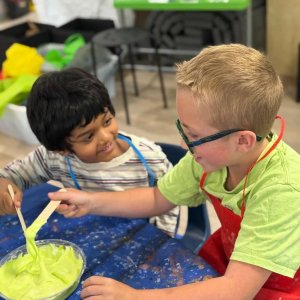
Blast Off into Space & Tech: Why AcadeCamp & AcadeCoders are the Ultimate Summer Destinations This Year
As the school year winds down, parents everywhere face the same annual puzzle: how do you find a summer camp that keeps your child’s brain active without burning them out? You want them to learn, but you also want them to run around outside, make friends, and just enjoy being

Friendships in Small Canadian Schools: The Benefits of Multi-Age Classrooms
Why Small Schools Support Strong Friendships in Canada One of the most common questions Canadian families ask about small schools is whether children will have enough opportunities to form strong friendships. Research confirms that children’s social development does not depend on large class sizes or numbers of peers. Instead, friendships

Why Learning to Learn Builds the Strongest Students
Many children are curious natural problem-solvers who ask thoughtful questions and enjoy learning. But simply meeting academic expectations does not always mean students are developing the thinking habits that sustain learning over time. Planning, reflecting, making connections, and adapting when challenges become more complex are part of learning how to

Advantages of Learning Multiple Languages at AcadeCap: A Global Benefit for Every Student
At École internationale Acadecap International School, there are many lifelong advantages of learning multiple languages. For over 20 years, we’ve helped students, including those with dyslexia and other learning differences, develop strong reading, writing, and communication skills in French, English, and Spanish. As the only Canadian school in the LabelFrancÉducation

Teaching Excellence at AcadeCap: A Blend of Expertise, International Standards, and Lifelong Learning
At AcadeCap International School, we believe that exceptional academics and education begins with exceptional educators. While Ontario private schools are not required to employ teachers certified by the Ontario College of Teachers (OCT) or individuals with teaching degrees, we take a different approach, one that exceeds the minimum requirements and

AI in Education – Benefits and Challenges for Meaningful Learning Experiences
The future of education and student engagement must blend innovation with a deeply human approach. AI is transforming classrooms around the world, offering new ways to support student learning and expand the possibilities of personalized education. According to recent research, 80% of students aged 13 to 18 already use AI

Festive iSTEAM activities
Leading up to the holidays, the students participated in fun, festive iSTEAM activities. The students were tasked with building a structure out of a variety of different shapes of cookies, and made some pretty interesting houses and buildings. They used their problem solving skills and creativity. The students also used
The Virtual Debates Continue…
The HIVE debating continued this week with a rousing game of “Take a Stand.” Students were presented with a topic statement and had to think about whether they strongly agreed or disagreed or somewhat agreed or disagreed and why. They then had to move their sticky note to the correct
Think about it! Question it! Debate it!
Debating is our AcadeCap monthly focus for January. The online tele-learning format did not stop the HIVE students from participating in an engaging first debate. Everyone had some great persuasive arguments and rebuttals. Students are looking forward to the second debate. The high school students did a wonderful job of

Give the Gift of Words
During the SMILE holiday party, students participated in reading games, wrote word and sentence ‘gifts’ to give to each other and decorated the windows with holiday messages. Happy Holidays Everyone! Source:: Mme Christine’s SLT Blog

Mitosis and Meiosis
Biology 10 and 11 students learn about mitosis and meiosis with hands-on microscope work and a virtual lab assignment. Source:: PSSP & OSSD

Making Groups
Early numeration skills, such as spontaneously grouping objects to simplify the count, are part of the Defi-Maths curriculum in Grade 1 and 2. In this activity, students were given a random large amount of manipulatives, and were tasked with organizing them to be easily count and identify how many each