
Blast Off into Space & Tech: Why AcadeCamp & AcadeCoders are the Ultimate Summer Destinations This Year
As the school year winds down, parents everywhere face the same annual puzzle: how do you find a summer camp that keeps your child’s brain active without burning them out? You want them to learn, but you also want them to run around outside, make friends, and just enjoy being

Friendships in Small Canadian Schools: The Benefits of Multi-Age Classrooms
Why Small Schools Support Strong Friendships in Canada One of the most common questions Canadian families ask about small schools is whether children will have enough opportunities to form strong friendships. Research confirms that children’s social development does not depend on large class sizes or numbers of peers. Instead, friendships

Why Learning to Learn Builds the Strongest Students
Many children are curious natural problem-solvers who ask thoughtful questions and enjoy learning. But simply meeting academic expectations does not always mean students are developing the thinking habits that sustain learning over time. Planning, reflecting, making connections, and adapting when challenges become more complex are part of learning how to

Advantages of Learning Multiple Languages at AcadeCap: A Global Benefit for Every Student
At École internationale Acadecap International School, there are many lifelong advantages of learning multiple languages. For over 20 years, we’ve helped students, including those with dyslexia and other learning differences, develop strong reading, writing, and communication skills in French, English, and Spanish. As the only Canadian school in the LabelFrancÉducation

Teaching Excellence at AcadeCap: A Blend of Expertise, International Standards, and Lifelong Learning
At AcadeCap International School, we believe that exceptional academics and education begins with exceptional educators. While Ontario private schools are not required to employ teachers certified by the Ontario College of Teachers (OCT) or individuals with teaching degrees, we take a different approach, one that exceeds the minimum requirements and

AI in Education – Benefits and Challenges for Meaningful Learning Experiences
The future of education and student engagement must blend innovation with a deeply human approach. AI is transforming classrooms around the world, offering new ways to support student learning and expand the possibilities of personalized education. According to recent research, 80% of students aged 13 to 18 already use AI

Kung Hei Fat Choi!
Kung Hei Fat Choi! Happy Lunar New Year! We listened to a story that taught us about the sinister Nian who wasn’t nice to the villagers at the beginning of each new year, so the villagers learned to scare him off with loud noises, bright lights, and the colour red.

Clash of the Ideologies
The HIVE students, in a fun collaboration between their Civics and History courses, participated in the ‘Clash of the Ideologies’ activity, which involved each student completing research on a specific political ideology and creating a short audio-visual presentation. For the presentation, we had some special guests in the audience, the

The Hour of Code
The kinders teamed up with their older school friends during The Hour of Code. They worked together to explore different coding tutorials. The younger children benefited from the knowledge and experience of their older buddies and enjoyed being able to help them solve awesome coding challenges. What is The Hour

Metabolic Processes
For the Metabolic Processes Unit, the Biology 12 students conducted investigations to determine the rates of cellular respiration and photosynthesis. They made predictions, explored direct and indirect methods of measurement, and investigated a variety of factors that influence metabolic rates in various organisms. Students practiced using their lab observations to

Thinking Critically about Bioplastics
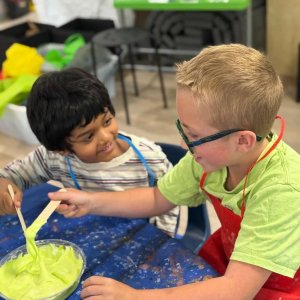
In Science 9, the students have become inventors of bioplastic and other plastic alternatives. They are exploring the chemistry of bioplastic, reading the recent research on the use of waste materials from agriculture to make bioplastics, and thinking critically about the societal, technological, and environmental challenges still associated with bioplastic

Illuminated Letters
Students experienced the detailed-oriented work that comprised illuminated letters and manuscripts. A respected art-form of the 7th century, performed by a team of monks (the parchmenter, the scribe, the illuminator), under a vow of silence. A vow which the students found troubling! 😁 As students drafted and created their final